Choose Your First AI Service To Sell
You will choose one beginner-friendly AI service and leave with one clear offer sentence plus a five-example demo plan.
Read the example, use one prompt, then check your result.
Step 1 of 5 · The lesson
Understand the useful idea.
Read the short plain-English explanation and inspect the example. Technical detail is optional, and the copy-ready prompt comes next.
The simple version
Start with one small job a business already repeats, such as replying to new leads, sorting common questions, or preparing a weekly report. You are not choosing a forever business. You are choosing one useful first service you can explain and demonstrate.
Your job
Tell your chosen AI agent which businesses you understand or can contact. Answer no more than three short questions, choose one recommendation, and save the finished service card.
Fictional-data example
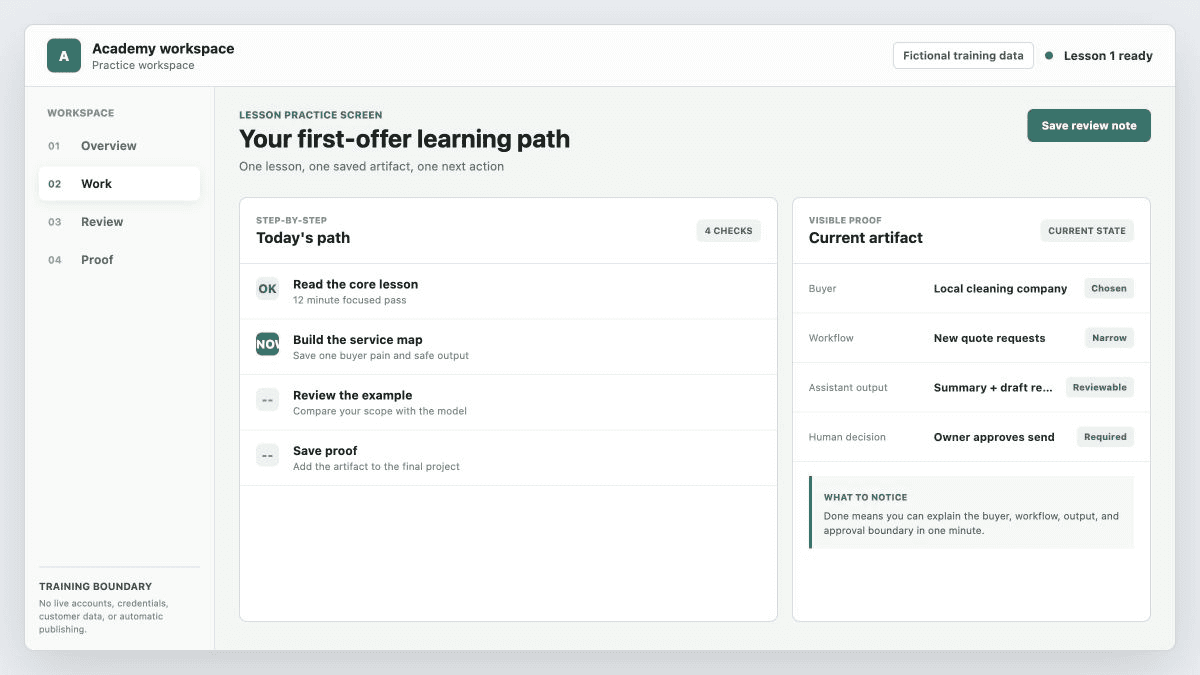
Buyer: a local cleaning company. Problem: quote requests arrive with missing details.
Your service: turn each inquiry into a short summary, missing-detail checklist and reply draft for the owner to approve.
Offer sentence: "I can build a small inquiry-review tool for your cleaning business, using five sample messages before we discuss live use."
You are selling the setup and tested workflow, not guaranteed bookings.
Check only these things
- The service names one type of buyer and one repeated problem.
- You can demonstrate the useful result with five clearly fictional examples.
- A person approves customer-facing decisions, and the offer promises no guaranteed income or results.
How this supports a paid offer
Use the finished service card to propose one small paid demo or pilot, not a vague all-in-one AI agency package.
Visual walkthrough
See how one service idea becomes a clear offer.
A beginner can see exactly how a vague AI-agent idea becomes one narrow service offer.
Optional: see more service examples and pricing notesOpen only when you want the explanation behind the agent's work.
Core idea: Do not try to sell AI. Sell help with one annoying job. The AI agent does the research and drafting; you choose the customer, check the result, and keep the promise honest.
Chosen-agent operating note: Use one capable project agent and keep using it. Paste the short lesson prompt, answer no more than three questions, and let the agent recommend and write the first version for you. No coding or account setup is needed in this lesson.
Lesson visual asset
Step-by-step
- Pick a business type you understand or can contact. Examples: cleaners, gyms, estate agents, ecommerce stores, coaches, or small agencies.
- Pick one task they repeat. Good examples are replying to leads, sorting inbox messages, answering common questions, or preparing a weekly report.
- Decide what the AI should prepare. Keep it simple: a summary, missing-detail list, draft reply, organized report, or checklist.
- Keep one human decision. A person approves prices, availability, policies, sending, publishing, or any sensitive answer.
- Write one offer sentence: "I help [business type] handle [repeated task] by preparing [useful result] for [human review]."
- Plan a demo with five fictional examples. You do not need a real client account or private data.
Three easy services to choose from:
- Lead follow-up helper: turns new inquiries into a summary, missing questions, and a draft reply.
- Inbox and FAQ helper: sorts common messages and drafts answers using approved facts.
- Weekly report helper: turns notes and numbers into a clear update with missing information flagged.
Worked example
Business: local cleaning company.
Repeated problem: quote requests arrive through forms and messages, often with missing details. The owner reads every message, works out what is missing, and writes each reply from scratch.
What the AI prepares: a short summary, the details already provided, the details still missing, and a polite draft reply.
What the human approves: the owner checks price, availability, address, and the final message before sending.
Offer sentence: "I help local cleaning companies respond to quote requests faster by preparing a lead summary, missing-detail checklist, and draft reply for the owner to approve."
Five fictional demo messages could include a normal request, a request missing the property size, an urgent request, a message asking for an unapproved discount, and a request outside the service area.
Why a business might pay: The owner starts from an organized draft instead of a blank screen and is less likely to miss an important detail. You are selling that practical improvement, not a promise of more customers or guaranteed revenue.
Starter offer: Begin with a small paid pilot containing only these pieces.
- A short conversation about the current process.
- Five to ten fictional or approved sample messages.
- One working demo or repeatable prompt.
- A review checklist showing what the owner must confirm.
- One revision and a short handoff note.
Common mistakes to avoid
- Choosing "all businesses" instead of one type.
- Trying to automate an entire company.
- Starting with medical, legal, financial, or other high-risk decisions.
- Using real customer messages without permission.
- Promising leads, revenue, saved hours, or automatic sending before you have proof.
- Talking about models, agents, databases, or APIs instead of the useful result.
How this can make money: Your first goal is not a giant agency contract. It is a small paid pilot you can explain and deliver carefully. A practice range might be $250-$500 for a tightly scoped fake-data demo and handoff, but the real quote depends on the buyer, work, access, support, and your local market. This is a learning example, not a guaranteed rate.
Let your agent do the heavy work: Let your chosen AI agent research the niche, compare service options, write the offer, create fictional demo inputs, and draft the first outreach message. You remain responsible for the promise, price, client relationship, private data, and anything sent or connected to a live account.
Pause and do this now
Paste the main lesson prompt into your chosen AI agent. Answer its questions, choose one recommended service, and save the finished one-page service card.
Quick quality check
- Can a business owner understand the service in one sentence?
- Does it solve one repeated task?
- Can you demonstrate it with fictional data?
- Is a person still approving customer-facing decisions?
- Did you avoid guaranteed money, clients, or results?
Safety and promise boundary: Use fictional or client-approved examples. Do not promise revenue, leads, saved hours, automatic sending, or any result you have not verified.
Completion checkpoint
You have chosen one business type, one repeated problem, one AI-assisted result, one human approval step, one offer sentence, and five fictional demo examples.
Save this for your final project
Your one-page service card with the buyer, problem, AI-prepared result, approval rule, offer sentence, and five demo examples.
Next step
Free Lesson 2 helps you turn this service card into a simple before-and-after demo a potential customer can understand.
Chosen-agent skill drill
- Your chosen AI agent: Ask your chosen AI agent to clarify "By the end, you should be able to answer five questions: Who will I help? What repeated task annoys them? What...", pressure-test assumptions, and make the lesson artifact reviewable as a checklist, documentation note, test note, structured draft, or implementation plan.
- Optional tool note: Codex and Claude Code can both use the same lesson prompt. Stay in one agent unless you intentionally want an optional second opinion.
- Optional OpenClaw lab proof: Use OpenClaw only when a fake-data screenshot or lab run helps prove the workflow result; otherwise keep the proof in the written artifact.
- Money angle: Your chosen AI agent handles the full work loop; OpenClaw only proves selected optional lab evidence. Connect the lesson to a paid service: name the buyer, the operational pain, the proof they would trust, and the smallest useful delivery.
- Done when: Save Your one-page service card with the buyer, problem, AI-prepared result, approval rule, offer sentence... with one sentence explaining how your chosen agent improved the work.
- Safety boundary: Use fake or sanitized data only; never paste API keys, customer records, private inboxes, billing screens, or live client systems into an assistant.
Step 2 of 5 · Use the prompt
Copy the prompt into your AI agent.
Paste the main prompt into the AI agent you chose, answer only what is needed, and inspect the finished artifact.
Use the finished service card to propose one small paid demo or pilot, not a vague all-in-one AI agency package.
You are my practical AI business helper. Help me choose one simple AI service I could learn to sell.

Ask me no more than three short questions about:
- businesses I understand or can contact;
- repeated work I notice;
- whether I prefer messages, reports, or a small app.

Then do the work for me:
1. Recommend three beginner-friendly services and rank them.
2. Choose the strongest one and explain why in one sentence.
3. Name the buyer and the repeated problem.
4. Explain what the AI prepares and what a person approves.
5. Write one plain-English offer sentence.
6. Create five clearly fictional examples for my demo.
7. Draft one short outreach message.
8. Name one claim I must not make.

Keep it simple. Do not give me code, setup instructions, APIs, databases, a giant agency plan, guaranteed income, or invented proof.

Done when I have one service card I can save and use in Free Lesson 2.- 1
Use the AI agent you already prefer and keep the whole lesson in that one tool.
- 2
Paste this prompt into a new chat or your existing project workspace.
- 3
Answer the questions that block progress, then ask the agent to show its result and test notes.
- 4
Check the result, use the review prompt if needed, and save the useful output.
What a good result looks like
- The service names one type of buyer and one repeated problem.
- You can demonstrate the useful result with five clearly fictional examples.
- A person approves customer-facing decisions, and the offer promises no guaranteed income or results.
Improve and quality-check the result
Review the work you just completed for "Choose Your First AI Service To Sell" as both a cautious buyer and a launch QA reviewer.

Check for:
- Confusing language a non-technical buyer would not understand
- Missing proof, tests, edge cases, or human approval steps
- Scope that is too large for a beginner's first paid project
- Secrets, private data, unsupported claims, or actions that should wait
- A weak connection between the work and a real buyer problem

Fix everything you safely can in the current workspace. Then give me only:
1. What you fixed
2. What still needs my decision
3. The strongest buyer-readable proof
4. The one next action that moves this closer to a paid offer

Do not invent client results, income, completed tests, or production readiness.
Turn the work into a small paid offer
Turn the finished work from "Choose Your First AI Service To Sell" into the smallest honest paid offer I could test with a real prospect.

Use the completed artifact and proof already in this workspace. Do not invent testimonials, clients, revenue, demand, or technical checks.

Return:
1. Best-fit buyer
2. Painful repeated workflow
3. One-sentence offer in plain business language
4. Fixed deliverables and clear exclusions
5. Proof I can show using fake or approved data
6. A conservative test price or pricing method, clearly labeled as an estimate rather than a market fact
7. One short outreach message with an easy yes/no next step
8. What must wait for owner approval, live accounts, domain, hosting, or production setup

Keep the offer small enough that a beginner could deliver it carefully. Include human review and no guaranteed outcome.
Safety rules the agent must follow
- No secrets, API keys, passwords, private customer data, or live credentials.
- Use fake data or anonymized examples until a real client gives written approval.
- Do not promise revenue, leads, guaranteed outcomes, or automatic customer-facing action.
- Ask for human approval before sending, publishing, buying, deleting, or changing live systems.
- Human approval is explicit before customer-facing use.
Step 3 of 5 · PracticeCheck what the agent madeUse the finished agent output, check it, and save one useful result.Short assignment
Need a plain-English definition?Open this only when a lesson term feels unclear.
Beginner decoder
Plain meaning, useful action, and what to avoid.
Use each plain meaning when a term sounds technical, then return to the exercise.
Agentic AI
An AI setup that can follow a goal through several steps instead of only answering one prompt.
Workflow
The repeatable business task you are trying to make easier, such as answering leads or sorting messages.
Fake data
Practice information that looks realistic but does not belong to a real customer, client, or account.
Human approval
A person checks the AI output before anything reaches a customer or changes a live system.
Postgres
The structured database where app records live, like leads, users, lessons, or purchases.
Short assignment
Try it with your chosen AI agent.
Paste the main lesson prompt into your chosen AI agent. Answer its questions, choose one recommended service, and save the finished one-page service card.
Check your result
- You have chosen one business type, one repeated problem, one AI-assisted result, one human approval step, one offer sentence, and five fictional demo examples.
- Human approval is explicit before customer-facing use.
Knowledge check
Try two quick checks.
Answer first, then compare with the example. You can ask your chosen AI agent to help you try the task.
A cleaning company misses details in quote requests. What could you offer first?
Reveal model answer
A small tool that summarizes each inquiry, flags missing details and drafts a reply for the owner. Start with sample messages, not a promise of more bookings.
Write one sentence naming your buyer, their problem and the small service you would build.
Reveal model answer
For example: I help cleaning businesses review quote requests by building a tool that spots missing details and drafts replies. Explain a useful result, not just an AI tool.
What you'll create
Save the useful work while it is fresh.
Keep this result for the demo summary part of your final project.
Your one-page service card with the buyer, problem, AI-prepared result, approval rule, offer sentence, and five demo examples.
Review checklist
- You have chosen one business type, one repeated problem, one AI-assisted result, one human approval step, one offer sentence, and five fictional demo examples.
- Keep one example, test result, or decision that shows what you actually completed.
- Human approval is explicit before customer-facing use.
Keep a copy of the result from your AI agent. Use the editable free worksheet, or sign in to save it here.
Both free lessons remain open without an account.
Step 4 of 5 · SellTurn this into a paid offerTranslate the result into a small offer a real buyer can understand.Optional sales step
How this can make money
Turn this lesson into a small service you can offer.
Name the buyer's problem, show what you made, keep the first offer small, and explain the result in language the buyer understands.
A small business you understand or can contact.
The owner repeats one annoying task, such as replying to leads, sorting questions, or preparing a report.
Offer one small paid demo using fictional examples: the AI prepares the work and the owner keeps final approval.
Lead with the task: 'I can show you a simple demo for handling [repeated task] without connecting your real accounts.'
Your one-page service card with the buyer, problem, AI-prepared result, approval rule, offer sentence, and five demo examples.
Quote only the demo, review checklist, and handoff. Live accounts and automatic sending stay outside the first project.
Offer builder
Turn this lesson into a buyer-ready mini offer.
Use this worksheet to turn the lesson result into a simple service promise: one buyer, one workflow, one result to show, an AI-assisted build process, and a sensible price boundary.
I help a small team turn one messy workflow into a safer AI-assisted review step with proof they can inspect before paying.
Deliverables
- One workflow map or buyer-readable artifact from this lesson.
- One chosen-agent planning and inspection note.
- A small proof checklist that shows the result, review rule, and exclusions.
What to show
- Your one-page service card with the buyer, problem, AI-prepared result, approval rule, offer sentence, and five demo examples.
- A buyer can see which painful workflow you can improve, why it matters, and where human approval keeps it safe.
- The artifact can be explained in plain language without leading with tool jargon.
Use the AI agent you chose to clarify buyer context, assumptions, workflow steps, risk, and scope, then inspect the artifact, tests, and reusable documentation before sharing.
Codex and Claude Code can both run this complete workflow. Continue in the one that already has your project context.
Use OpenClaw only as selected fake-data lab proof when a visible dashboard, gateway, or workflow demo makes the claim easier to trust.
Keep the buyer or operator in the approval seat before anything customer-facing, live, or sensitive happens.
This is an offer-building exercise, not an income claim: no guaranteed clients, guaranteed income, fake testimonials, private-data demos, or unmanaged live automation.
How to pitch it
Explain this service in clear client language.
Use this before outreach or discovery. Explain the problem, show the result, suggest a small first project, and be clear about what the AI should not do.
I help small teams turn one messy workflow into a safer, reviewable AI-assisted service step.
I can show the buyer result, proof artifact, chosen-agent review evidence, and the boundary that keeps the first step honest.
Discovery questions: Ask these before pitching
- Which workflow do you repeat often enough that a better first draft would matter?
- What proof would help you trust a small pilot?
- Where should a human stay in control before anything reaches a customer?
Would it be useful to map one small workflow and decide whether a fake-data pilot is worth building?
Send a concise recap with workflow pain, proof asset, first paid scope, exclusions, and next question.
The lesson proof to bring into this conversation is: Your one-page service card with the buyer, problem, AI-prepared result, approval rule, offer sentence, and five demo examples.
Extra helpSee an example or use a downloadOpen a finished example or download when you need another model to follow.Examples and files
Lesson kit
Review the examples or keep the worksheet beside you.
Recommended downloads
Keep the workbook or worksheet open while you complete this lesson.
Step 5 of 5 · FinishComplete and continueConfirm the result is clear, mark the lesson complete, and move to the next useful action.About one minute
Final clarity check
Ready for the next lesson?
Save your result and check that you can explain what you made and its limits. If something is unclear, ask for help before moving on.